Breed or line? Dominant or recessive gene? What is the difference between a colour variety and a mutation? A glossary of the basic terms you will keep meeting in every article in our Japanese quail genetics series.
This article is the introduction to a series about Japanese quail genetics. It collects the terms that are repeatedly used when describing colour varieties, crossing and breeding. Each definition has its own anchor link, so other articles can link directly to it. You do not need to read the article from start to finish, just use it as a glossary.
1.Classification of organisms
Let us start with the broadest concepts. These four terms explain what category a particular quail belongs to and why it is not correct to call Pharaoh a breed.
Species
A species is the basic taxonomic unit in biology. All farmed Japanese quails belong to a single species,
Coturnix japonica (Japanese quail). Regardless of colour, weight or origin, it is still the same species.
Pharaoh,
Manchurian Golden and
Pearl are colour varieties of the same species, not separate species.
Breed
A breed is a stabilised group of individuals within a single species that has heritable traits distinct from other groups of the same species. In chickens, for example, Leghorn or Plymouth Rock are breeds. With Japanese quail the term breed is used very loosely. Most names such as Pharaoh, Italian or English White actually denote colour varieties or lines, not real breeds in the zoological sense.
Line (breeding line)
A line is a group of individuals within a species or breed with a common origin and a deliberate breeding programme. A line can be selected for greater weight, higher egg production or a specific colour. A line is maintained by a particular breeder or group of breeders and often carries the name of its founder, region or breeding goal. For example, the Texas A&M line was developed at Texas A&M University in the USA by selecting for white feathering and fast growth for meat production.
Colour variety
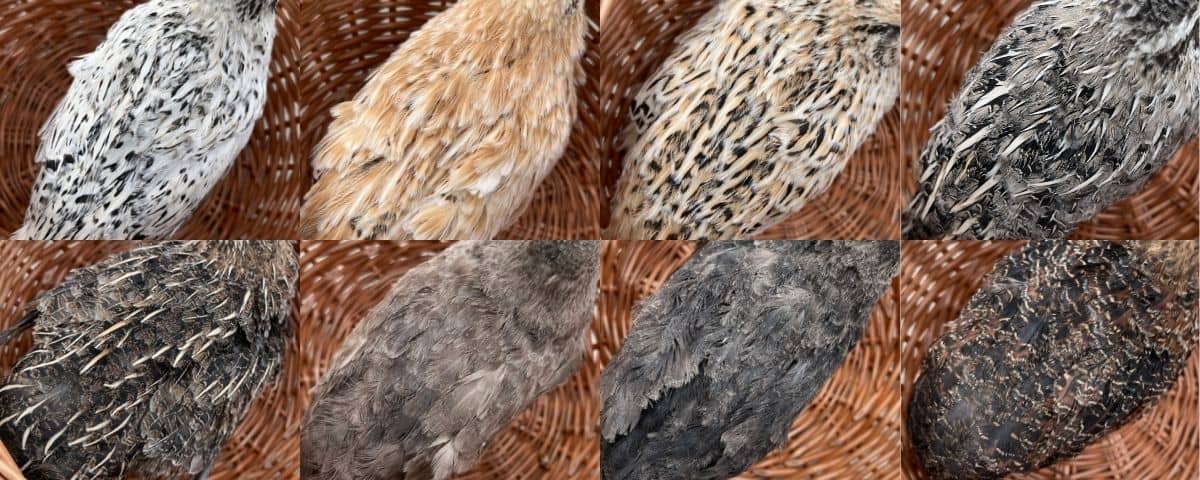
A colour variety is a group of individuals within a single species that differs from the others in the colouring of feathers, skin or eyes. It arises through the presence of one or more colour mutations. Among Japanese quail breeders the well-known varieties include Pharaoh (natural brown), Manchurian Golden, Pearl, Tibetan, Cinnamon or English White. The same variety may be called by different names in different countries.
2.Genetics fundamentals
These terms describe how traits are passed from parents to offspring. Understanding the difference between dominant and recessive alleles is the key to why two seemingly identical quails can produce chicks of a different colour.
Gene
A gene is a section of DNA that carries information about one specific trait, for example the colour of feathers, body weight or egg size. Every individual has two copies of every gene: one inherited from the mother and one from the father.
Allele
An allele is one of the possible variants of the same gene. For the gene that controls feather colour there is an allele for natural brown colouring and an allele for yellow, for instance. An individual always carries two alleles (one from each parent). If both are the same we speak of a homozygote; if they differ we have a heterozygote.
Dominant allele
A dominant allele is one that shows up in the phenotype even when only one copy is present in the genotype. It is enough for the individual to inherit it from a single parent for the trait to be visible. In technical writing, dominant alleles are denoted by an uppercase letter (for example S for the Sparkly gene).
Recessive allele
A recessive allele only shows up in the phenotype when it is present in two copies in the genotype (the individual has inherited it from both parents). If only one copy is present, the individual is a so-called carrier: the allele is in the genotype but is not visible in the phenotype. In technical writing, recessive alleles are denoted by a lowercase letter (for example r for the Roux gene).
Homozygote
A homozygote is an individual that carries two identical alleles for a given gene (it inherited the same variant from both parents). Homozygous individuals always pass the same allele to their offspring and are essential for breeding stable, fixed lines.
Heterozygote
A heterozygote is an individual that carries two different alleles for a given gene (one from each parent). For coat or feather colour, only the dominant allele will show in the heterozygote's phenotype. The recessive allele is, however, passed on to half of its offspring, which is why two seemingly Pharaoh parents can produce chicks of a different colour.
Genotype
A genotype is the sum of all the genes an individual carries in its DNA. It includes alleles that are not visible from the outside (for example recessive alleles in a heterozygote). Two individuals with the same phenotype can have different genotypes (they look the same, but can produce different offspring).
Phenotype
A phenotype is the sum of an individual's observable and measurable traits: feather colour, body weight, egg size, behaviour. The phenotype is the result of the genotype combined with the influence of the environment (feeding, temperature, stress). When breeding, you select individuals based on the phenotype, but it is the genotype that gets inherited.
3.Mutations and colouring
All Japanese quail colour varieties other than Pharaoh originated from mutations. These terms describe how the original colouring changed and how the colour lines came into being.
Wild type
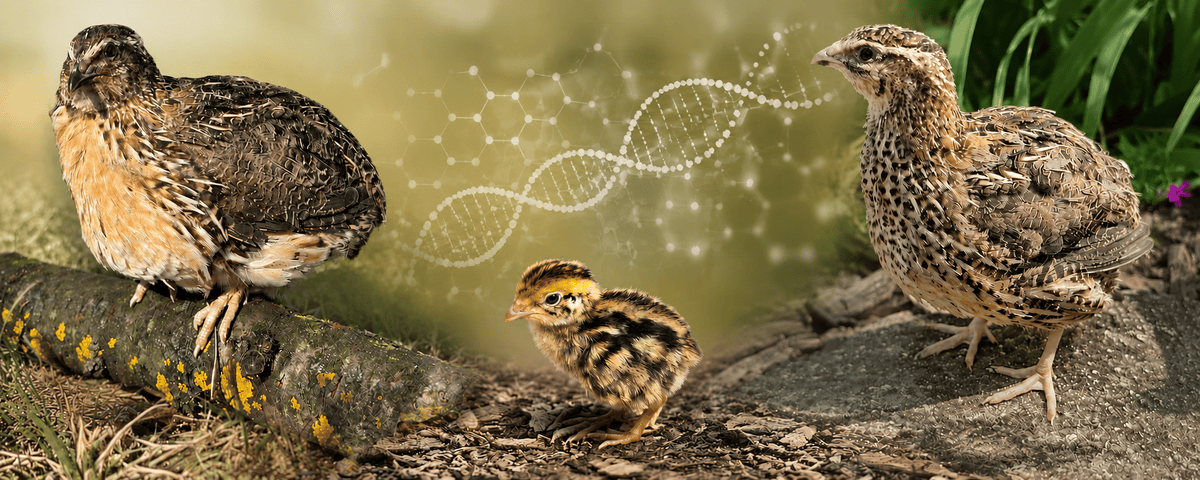
The wild type is the original, natural form of a species, the form that occurs in the wild without breeder intervention. In Japanese quail the wild type is Pharaoh: brown colouring with golden vertical lines. All other colour varieties arose from mutations that are deviations from the wild type.
Mutation
A mutation is a permanent change in DNA that can affect one or more traits of the individual. For feather colour, a colour mutation arises that changes or suppresses the original pigment and creates a new colour variety. Most colour mutations in quail are recessive, which is why they can stay hidden in a population for years before they show up in the phenotype.
Colour mutation
A colour mutation is a specific type of mutation that affects pigment in the feathers. Known colour-related genes in Japanese quail include Fawn (golden colouring), Fee (suppression of brown), Sparkly (enhanced black barring), Extended Brown (darker brown plumage in the Tibetan variety) and Recessive Black. Combinations of several colour mutations produce new varieties, for instance Pearl (Fee + Fawn).
4.Breeding and husbandry
The final group of terms describes how concrete lines emerge from genetic theory. These terms describe the breeder's work: selection of individuals, controlled mating and maintaining the purity of the line.
Selection
Selection is the deliberate choice of individuals for further breeding according to chosen criteria: weight, egg size, colour, egg-laying performance. The goal of selection is to shift the average traits of the flock in the desired direction. Selection is the opposite of random crossing: the breeder consciously rejects individuals that do not match the goals.
Selective breeding
Selective breeding is a long-term process in which the breeder combines selection with controlled mating of specific individuals. The goal is to fix the desired traits and create a new line or colour variety. Selective breeding can take several years before a new trait is sufficiently fixed.
Pure line
A pure (purebred) line is a breeding line in which individuals have been bred only with each other for a long time and are homozygous for the main traits of the line. A pure line produces offspring with the same traits as the parents. In practice, pure means that for at least 5 to 7 generations there has been no deliberate crossing with another line.
Jumbo
Jumbo is not a breed and not a colour, it is a label for a line selectively bred for above-average weight. A Jumbo quail weighs roughly 350 to 450 g, while a standard laying line weighs about 180 to 250 g. Selection for Jumbo size originated in the USA and Canada and can be applied to any colour variety, which is why Jumbo Pharaoh, Jumbo Golden and Jumbo Pearl all exist.