Quails in Space: The First Birds Hatched in Orbit
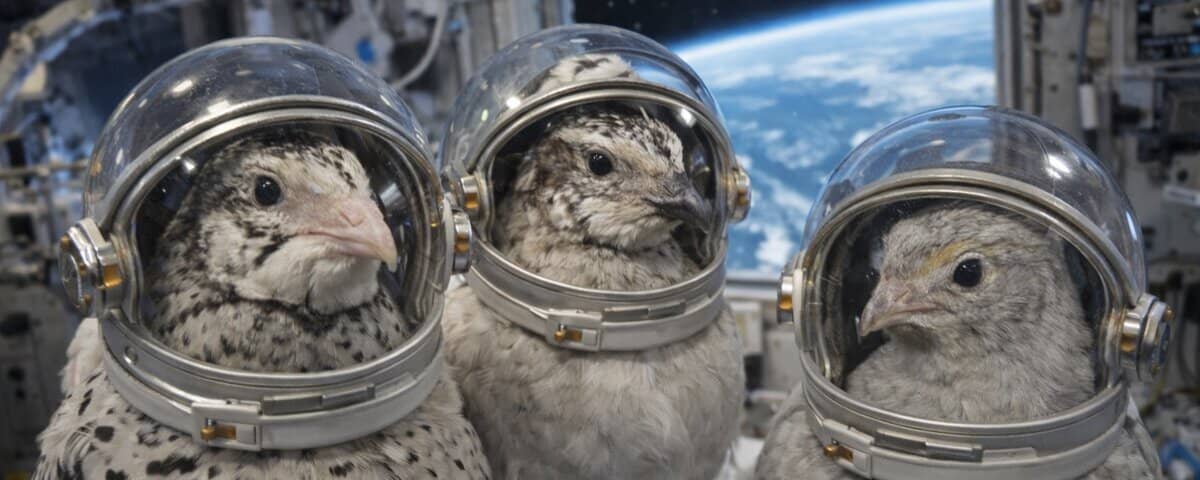
A quail in space? Sounds like a joke, but it's true. Japanese quails have been flying to orbit since 1979, and in 1990 they became the first birds, even the first vertebrates, to hatch outside our planet.
Why Quails?
When scientists were looking for a bird suited for space, the quail won hands down. Not for its looks, but for purely practical reasons.
First Attempt: 60 Eggs, 1 Survived
The first attempt came in 1979. Aboard the Cosmos 1129 satellite were 60 quail eggs in a special incubator. The plan was simple: the eggs would hatch in space and scientists would have their answer. But nothing went as planned. The humidity system broke down, the embryos dried out, and out of all sixty eggs only a single embryo survived.

Even that single embryo showed something important. It developed completely normally. Gravity apparently isn't as essential for development inside the shell as everyone thought.
Meanwhile in America: Chickens
While the Soviets were improving their incubator, the Americans took interest in space eggs too. They loaded 32 chicken eggs onto the Discovery space shuttle. Half had been incubated on Earth for just two days, the other half for nine days. They wanted to find out whether microgravity affects embryos at different stages of development.
The whole experiment was the brainchild of an eighth-grader from Indiana who was inspired by raising chickens at home. His project caught NASA's attention and was sponsored by Kentucky Fried Chicken. It was originally supposed to fly on the Challenger in 1986, but after the launch tragedy it was moved to Discovery.
After five days in orbit, the eggs returned to Earth. The younger embryos didn't survive as their development stopped in microgravity. The more mature eggs did hatch, but only after returning to Earth, not in space. It seemed that hatching in orbit was simply impossible.
The Day History Was Made
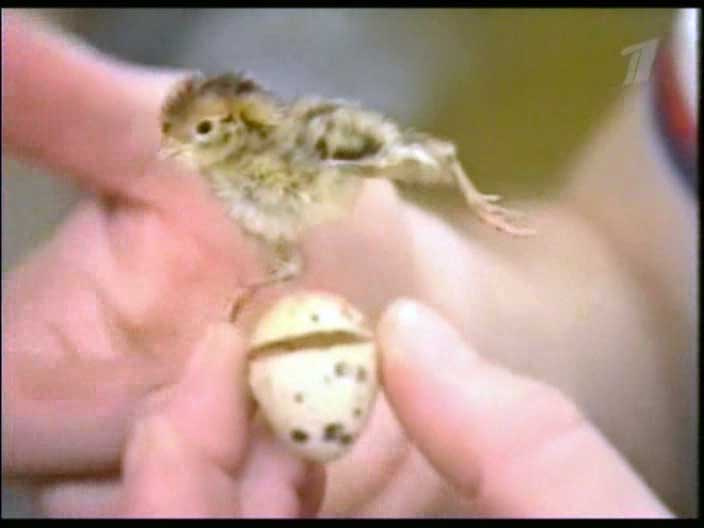
Chickens failed. But quails didn't. On the Mir station, the Soviets tried again with an improved incubator and 33 eggs. On March 22, 1990, day seventeen of incubation, right on schedule, a chirping sound came from the incubator. The first quail chick that had never stood on the ground was born. In total, 8 chicks hatched from 33 eggs. Not a lot, but enough to go down in history as the first vertebrates ever hatched in orbit.

Archive footage of quail experiments on the Mir station (source: YouTube)
Chicks That Couldn't Feed Themselves
The joy didn't last long. On Earth, quail chicks are independent right after hatching, they run, peck, and search for food. In space, they tumbled chaotically through the air, flapping their wings but just spinning in circles. They couldn't focus their eyes on anything, and without that you can't peck. The cosmonauts had to hand-feed them every two hours using squeezable tubes with paste. Later, they even sewed tiny vests so the chicks could hold on and feed themselves.


The Slovak Connection: Ivan Bella and Mission Štefánik
In 1999, space quails got a Slovak chapter. Ivan Bella, the first Slovak cosmonaut, flew to Mir with 56 quail eggs in a special Slovak-designed incubator called SK-6. The results surpassed all previous attempts. 36 chicks hatched, a success rate of nearly 65 %, the best in the entire history of these experiments.
Not everything went perfectly, though. One chick hatched with four legs and during the return to Earth the Soyuz capsule was only about 10 °C, so seven out of ten chicks didn't survive the trip back. Three did make it back alive, together with Ivan Bella. Slovakia played a key role in one of the most fascinating space experiments in history.
What Space Quails Taught Us
Over twenty years of experiments, scientists found that embryos develop almost normally in space and gravity isn't needed for development inside the shell. Eggs hatched on day seventeen, just like on Earth. The problem begins after hatching, when chicks without gravity can't orient themselves, walk, or eat. Interestingly, some of these findings have influenced everyday quail keeping too. Proper egg turning in incubators, humidity control, precise temperature of 37.7 °C (the Slovak SK-6 incubator was set to 37.3 °C). Much of what breeders consider basic was also confirmed by space research.
Japanese quail breeder and founder of Cipinkovo, focused on genetics and selective breeding. I write about what I have learned over years of practice.