Problems with Newly Hatched Quail Chicks: How to Recognize and Fix the 9 Most Common Issues

9 chick problems to watch for
We have ordered the problems from the most common and easiest to treat to the most serious and congenital defects. Each card contains a brief description, cause, exact treatment steps, and prevention for future hatches.
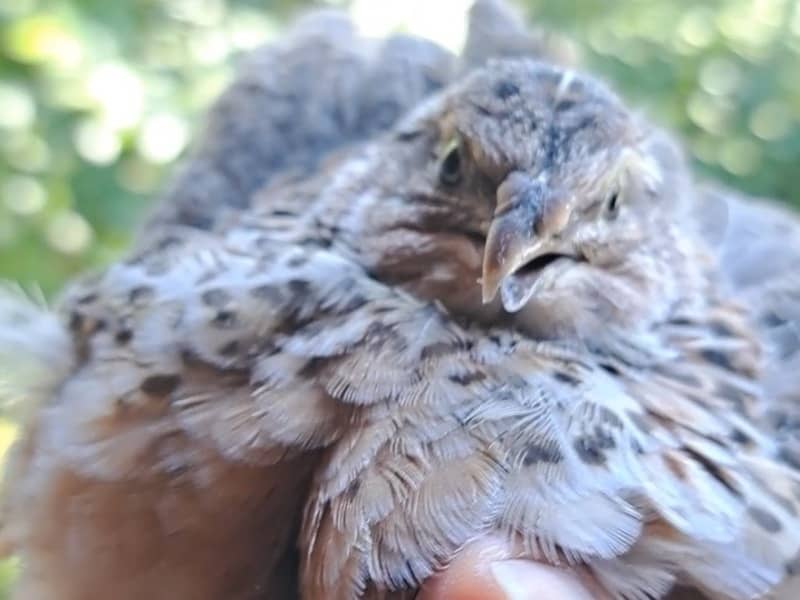
1. Scissor beak (cross beak)
MildThe upper and lower parts of the beak do not meet straight but are offset sideways from each other (hence "scissor" or "crossed beak"). In mild cases the quail can live a full and happy life, while severe cases struggle to pick up feed and gradually lose weight.
- How to recognize
- Looking at the head from the front, the upper and lower beak do not overlap symmetrically and one side is deviated sideways. Sometimes the beak is not fully crossed but merely asymmetric, and the quail cannot close it completely even when both parts are in the same plane. The defect often appears only in the second or third week of life and usually worsens as the bird grows.
- Cause
- A recessive genetic mutation (a semi-lethal autosomal gene). This means that an inherited defective gene does not have to show outwardly, but the chick becomes a carrier and can pass it on to its offspring. The problem therefore hides in flocks and only fully appears when two carriers are paired, which is typical in inbreeding. A study confirmed a fivefold higher occurrence of scissor beak under inbreeding. Source: BMC Vet Res, 2018
- Treatment
- There is no cure, but in mild cases the quail lives a full life without problems. In severe cases, where the quail cannot feed itself, hand feeding is necessary.
- Prevention
- Do not cross closely related quail. Refresh the parent flock with new bloodlines from reliable breeders. Do not set eggs from affected parents, the trait is hereditary.
- Heritability
- Strongly hereditary. A recessive autosomal semi-lethal gene. Even when the defect does not show outwardly in the offspring, the bird can remain a silent carrier of the gene and pass it on further, so such birds should never be used for breeding.
2. Pasty butt (pasted vent)
MildDroppings stick to the down around the vent and form a hard plug that blocks elimination. Left untreated, the chick dies within a few days.
- How to recognize
- A dried brown or yellowish lump on feathers around the vent. The chick is often separated from the group, does not preen, and the rear is wet and dirty.
- Cause
- Most often inappropriate feed, typically chicken starter with low protein instead of quail starter, or offering treats. Other causes include stress from cold, overheating under a heat lamp, sudden temperature change after moving from the incubator, or bacterial infection.
- Treatment
- Hold the chick's rear under lukewarm (not hot) running water and gently work the dried droppings off with your fingers. Do not pull, or you will tear the skin. Dry thoroughly with a towel and a hair dryer on the lowest setting until the chick is fully dry.
- Prevention
- Feed a quality quail starter. In the first days add a little apple cider vinegar or cooled brewed black tea to the water, both help support digestion and gut flora. Keep the brooder temperature stable and check vents during the first week.
- Heritability
- Not hereditary. It is purely an environmental and management issue.
3. Dehydration
MildFreshly hatched chicks do not instinctively know they need to drink. In a warm brooder they can die from dehydration within hours even with water right next to them.
- How to recognize
- The chick is apathetic, eyes are sunken, wings droop and it has stopped moving. In advanced cases it lies on its side and cannot keep balance.
- Cause
- The chick cannot recognize water as a source of fluid, the drinker is too deep or too high, or the brooder temperature is too high.
- Treatment
- Take each chick gently in your palm and dip its beak into a shallow dish of water with a pinch of electrolytes. Repeat 3 to 4 times in the first hour. Most chicks recover within 2 hours.
- Prevention
- Use a shallow dish with white glass marbles or round pebbles (shiny objects attract chicks' attention). Immediately after moving from the incubator, dip each chick's beak into the water as an introduction to drinking.
- Heritability
- Not hereditary. It is a pure management issue that you fix with proper brooder setup.
4. Spraddle leg
SeriousOne or both legs slip out to the sides and the chick cannot stand or walk. Without intervention the chick will not survive because it cannot reach food and water.
- How to recognize
- The chick sits on its rear with legs splayed outward, and when it tries to walk they slide further apart. It appears on the first or second day after hatching.
- Cause
- Most often a slippery surface in the incubator during hatching or in the brooder in the first hours. Other causes: riboflavin (vitamin B2) deficiency from the parents or a difficult hatch.
- Treatment
- Gently bring the legs closer together to a natural distance, but never fully pressed together. Use a piece of string, medical tape (leukoplast) or self-adhesive elastic wrap (vetrap). Wrap one leg, connect with a short loop and wrap the other so that about 1.5 cm remains between them, the same as in a healthy chick. Never tighten the wrap too much, as excessive pressure will cut off blood circulation and damage the leg. Leave the wrap on for about 24 hours, then carefully remove it and watch whether the chick can stand on its own. If the legs splay apart again, reapply the wrap for another 24 hours and repeat.
- Prevention
- Before lockdown, line the incubator floor with paper towels or rubber shelf liner. Never use newspaper or bare plastic in the brooder. For the first week, paper towels changed daily are the safest choice.
- Heritability
- Not directly hereditary, but indirectly linked to riboflavin (vitamin B2) deficiency in the parents' diet.
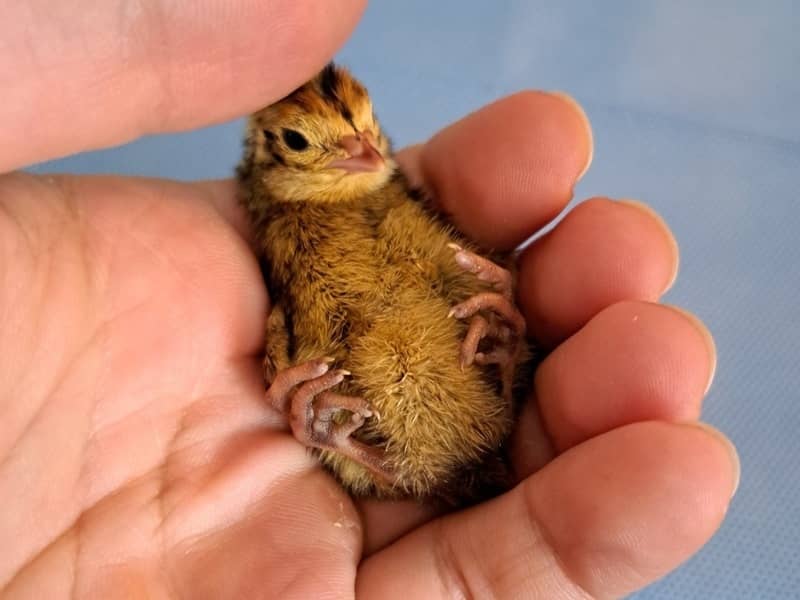
5. Curled toes
SeriousThe toes are curled inward into a fist shape instead of laying flat on the ground. The chick walks on its joints and gradually injures them.
- How to recognize
- Toes are fully or partially bent down or inward. The chick cannot firmly grip the surface and stumbles when walking.
- Cause
- Most often incorrect incubator parameters (temperature, humidity), embryo position, or sciatic nerve damage during development. It can also be linked to riboflavin (vitamin B2) deficiency in the parents' diet.
- Treatment
- While the chick's bones are still soft (first 2 to 3 days), straighten the toes by hand into a natural position. Cut a splint from thin cardboard in the shape of the foot, place the toes on it and secure with tape. The splint holds the toes straight while the bones firm up. Check after 24 hours.
- Prevention
- Maintain precise incubation parameters (37.7 °C, 40 % humidity in the first 14 days). Feed parents quality feed rich in riboflavin.
- Heritability
- The problem can be linked to riboflavin deficiency in the parents' diet, but it can also be partially hereditary. The heritability is not high, yet we do not recommend using a corrected chick for further breeding.
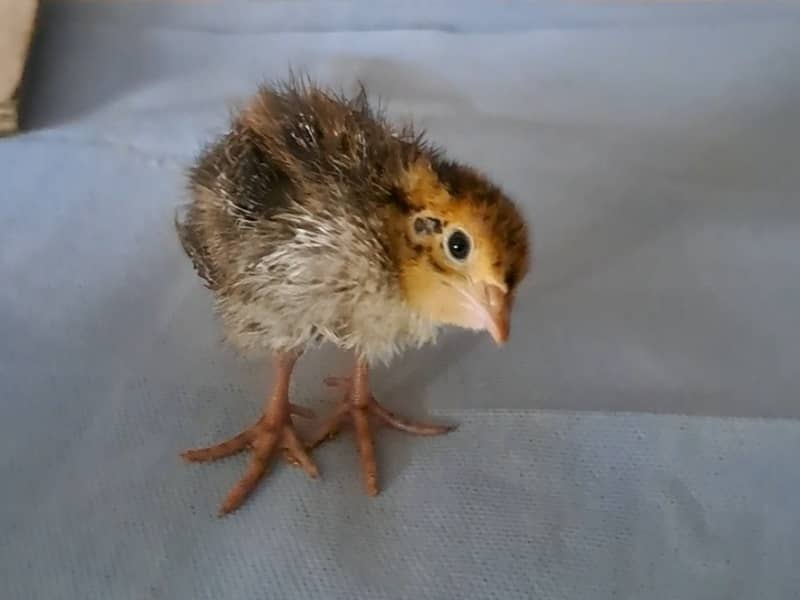
6. Wry neck (torticollis / stargazing)
CriticalA neurological disorder in which the chick's neck is twisted sideways or fully backward so that it looks at the ceiling. It often circles or falls on its back. It cannot feed or drink without help.
- How to recognize
- Head turned to the side or backward (hence "stargazing"), walking in circles, loss of balance, inability to drink on its own.
- Cause
- The main cause is vitamin E and selenium deficiency in the parent flock's diet. Other causes: genetic predisposition, mechanical neck injury during hatching, bacterial or viral infection. Source: MSD Veterinary Manual
- Treatment
- Milder cases can live a full life without problems. In more severe cases, isolate the chick from others so it does not get trampled. Administer AD3E drops directly into the beak 2 to 3 times daily. Improvement can come within 24 hours, but treatment takes 2 to 4 weeks. Not all chicks recover fully.
- Prevention
- Provide the parent flock with quality feed rich in vitamins, especially vitamin E and selenium. Do not open the incubator during hatching, a sudden drop in humidity and temperature can harm chicks at the most critical stage.
- Heritability
- Mostly not hereditary (under 10 % transmission probability), the main cause is parent nutrition and mechanical injury during hatching. Some lines carry a partial genetic predisposition. If wry neck recurs despite a feed change, replace the parent flock.
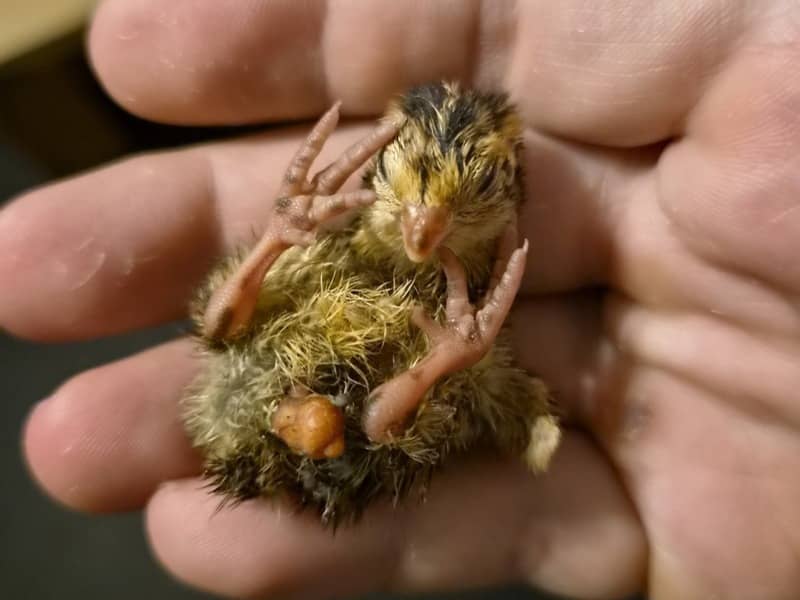
7. Unhealed navel and prolapse
CriticalAfter hatching, the opening in the abdominal wall left by the yolk sac fails to close and part of the remaining yolk, or sometimes a loop of intestine, protrudes through the hole. It is one of the deadliest post-hatch problems, and in most cases with visibly herniated organs the condition is practically untreatable.
- How to recognize
- A visible protrusion on the abdomen of a freshly hatched chick, either yellowish (yolk remnant) or reddish (intestinal loop). The navel is open, wet or bloody. The chick is weak, bloated and refuses to stand.
- Cause
- Incorrect humidity during incubation. High humidity prevents the yolk from being absorbed in time before hatching. Too high a temperature causes premature hatching before absorption is complete, while too low a temperature leads to underdeveloped embryos. Other causes: premature assisted hatching, dirty or poorly disinfected incubator.
- Treatment
- In mild cases the remaining yolk can be absorbed on its own. In severe cases with visibly herniated organs, the only humane option is euthanasia so the chick does not suffer.
- Prevention
- Maintain precise incubation parameters throughout: 37.7 °C and 40 % humidity on days 1 to 14, and 60 to 65 % during lockdown. Never help chicks out of the shell prematurely. Thoroughly disinfect the incubator between batches.
- Heritability
- Not hereditary. It is purely an incubation parameter error, primarily humidity and temperature.

8. Deformed beak with missing eye
CriticalA combined congenital defect where the beak is severely twisted (the upper part is often rotated 90 degrees from the lower one) and the eye on the same side of the head is missing or underdeveloped. The chick cannot recognize or pick up food and the prognosis is poor.
- How to recognize
- A visibly deformed beak right after hatching, often combined with a closed or completely absent eye socket on one side. The chick walks into walls, cannot find feed and weakens rapidly.
- Cause
- Most often temperature fluctuations in the incubator during the first days of incubation, when the head and sensory organs are forming. A typical trigger is a power outage lasting several hours during which the incubator temperature drops outside the optimal range. A less common cause is a genetic defect.
- Treatment
- The condition cannot be treated. The chick suffers, cannot feed or drink without help, and would never be able to live a normal life. The only humane option is euthanasia as soon as the condition is recognized.
- Prevention
- Protect the incubator against power outages with a UPS (uninterruptible power supply) or battery backup. If an outage occurs, wrap the incubator in a blanket or heavy cover so the temperature drops as slowly as possible.
- Heritability
- Mostly not hereditary (under 5 % transmission probability). It is a developmental defect caused by temperature fluctuations during early incubation. A genetic defect may rarely contribute, but this is the exception.
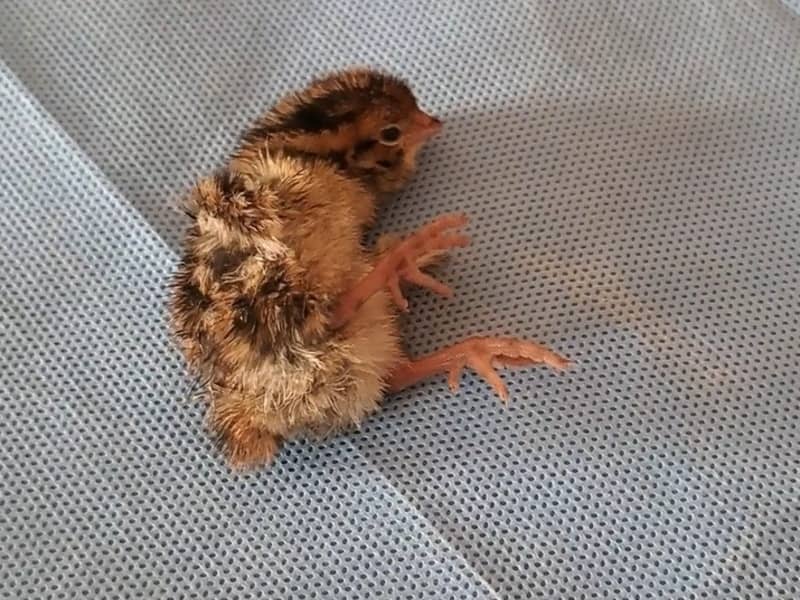
9. Weak chick syndrome (disrupted hatch)
CriticalThe chick hatches physically weak, typically lying on its side with legs stretched straight behind and unable to stand on its own. When lifted up, it collapses back to its side within seconds. The toes are fine (so it is neither spraddle leg nor curled toes), yet its motor function does not work.
- How to recognize
- A lying posture on the side immediately after hatching, legs stretched straight backward, slack muscles. The chick appears exhausted and struggles unsuccessfully to stand. Other chicks in the same batch are usually fine, the problem affects individuals rather than the whole batch.
- Cause
- Most often a disruption of incubator conditions during active hatching, typically opening the lid while chicks are pipping the shell. A sudden drop in humidity and temperature dries out the membrane, which then sticks to the chick (shrink-wrapping) and restricts its movement at the most critical moment. The chick either exhausts itself trying to get out, or suffers damage to its muscle and nerve development. Some breeders colloquially attribute this state to "spinal damage" during hatching, but the spine itself is usually fine, the real problem is general muscular weakness and exhaustion. Other contributing factors: inadequate ventilation (high CO2) and poor chick position in the shell in the last days of incubation.
- Treatment
- This is not a classical disease with targeted treatment, only supportive care helps. Isolate the chick from the others so it is not trampled and place it in a warm soft nest of paper towels. Hand water it (dip the beak into water with electrolytes) and hand feed it (quality starter directly in front of the beak). Two to three times a day, gently lift it onto its legs and hold it for a few seconds so the muscles remember the correct position. Some chicks manage to stand on their own within 2 to 3 days. If there is no improvement after 3 to 4 days, the prognosis is poor and the most humane option is euthanasia.
- Prevention
- Once pipping begins (when chicks start tapping the shell), do not open the incubator until hatching is completely over. Every opening sharply lowers humidity and endangers chicks that are currently hatching. If you must move hatched chicks to the brooder, do it all at once as quickly as possible, not one by one.
- Heritability
- Not hereditary. It is an environmental problem caused by poor incubator management during hatching, unrelated to parent genes.
How to prevent most of these problems
Most post-hatch problems can be prevented with a few simple measures. Even with the best setup, however, it is perfectly normal for one of these issues to appear from time to time.
| Measure | Prevents |
|---|---|
| Do not open the incubator during hatching. Every opening sharply drops humidity and temperature. | Weak chick syndrome, unhealed navel and prolapse |
| Maintain correct temperature and humidity in the incubator throughout the entire incubation. | Curled toes, unhealed navel and prolapse, deformed beak with missing eye |
| Feed parents quality feed with sufficient vitamins (E, selenium, riboflavin). | Wry neck, curled toes, spraddle leg |
| Do not cross closely related quail and refresh the parent flock with new bloodlines. | Scissor beak, curled toes |
| Use a non-slip surface in the incubator and brooder. | Spraddle leg |
| Feed chicks a quality quail starter. | Pasty butt |
| Shallow drinker with pebbles and dip each chick's beak into water right after transfer. | Dehydration |
| Protect the incubator with a UPS (uninterruptible power supply) against power outages. | Deformed beak with missing eye |
If you are struggling with parent flock nutrition or are not sure what your chicks need, do not hesitate to contact us. We are happy to help.
The best treatment is the one you do not have to do. If you do not want to risk hatching problems, order healthy chicks directly from our farm.
Order chicks