Italian and Manchurian quail: what is the difference?
How to tell Italian and Manchurian quail apart
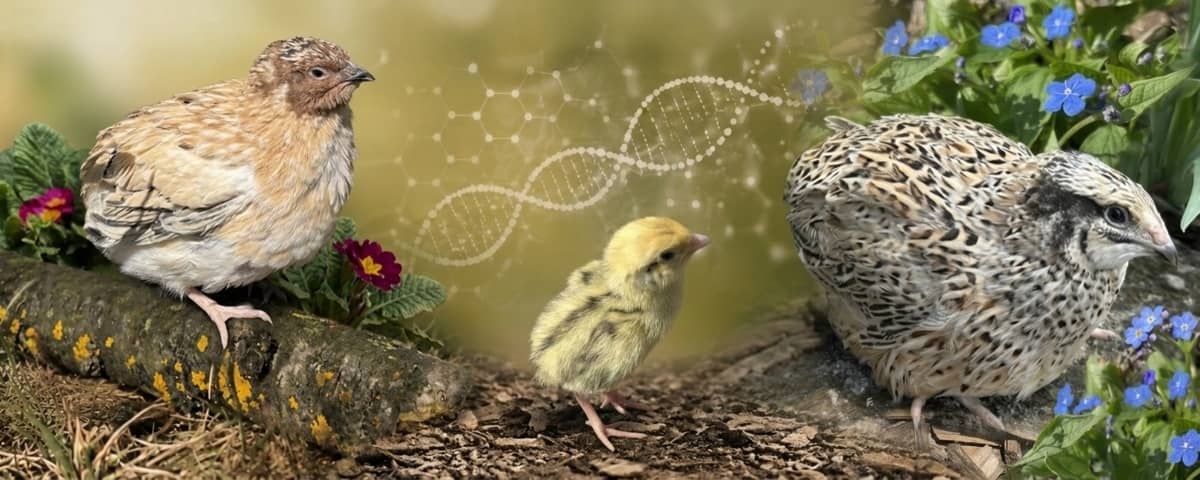
Italian and Manchurian quail are both golden colour varieties of the Japanese quail Coturnix japonica. At first glance they look alike, but the feather markings tell them apart reliably.
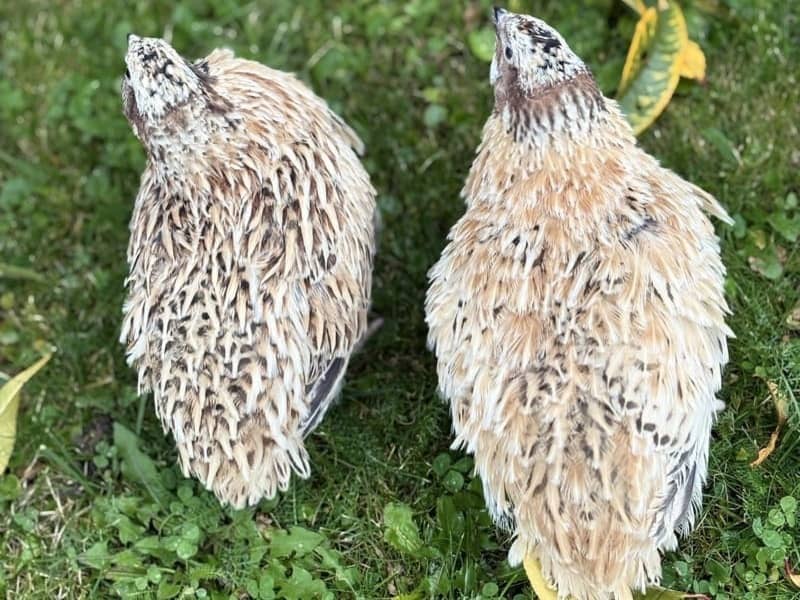
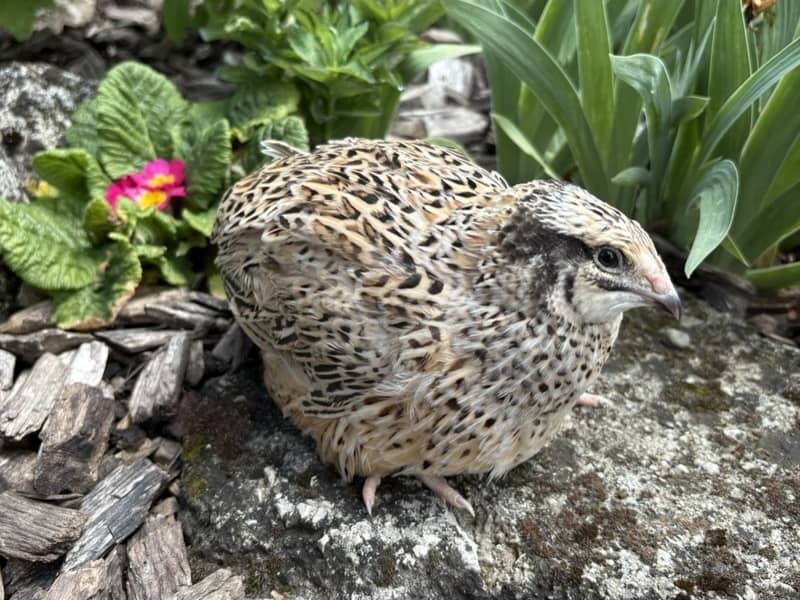
- Italian quail have a rich golden-yellow colour with bold markings. The feathers on the back and wings carry black and reddish V-shaped marks that still resemble the original Pharaoh pattern.
- Manchurian quail are lighter, straw yellow. They have far less black marking, often just small separate specks, and look more uniform overall.
Males and females of both varieties differ in the same way as in Pharaoh. The male has a smooth rusty-orange breast without spots, the female has a cream breast with black spots. A Manchurian female has fewer breast spots than an Italian one.
Overview of all pairing combinations
The table lists all pairing combinations of Manchurian and Italian quail. The percentages are statistical ratios over a larger number of chicks.
One gene, two copies: what it means
The golden colour of both Italian and Manchurian quail comes from the same gene, which breeders call Fawn. Imagine that every quail has two slots for this gene. Each slot either holds a copy of Fawn or it does not.
- Manchurian has Fawn in both slots, so two copies.
- Italian has Fawn in only one slot, the other slot is "empty".
- Pharaoh has Fawn in neither slot, which is why it shows the wild, natural colouring.
Each parent passes one of its two slots to the chick at random. The chick gets the other slot from the other parent.
The simplest case is two Manchurian parents. A Manchurian has Fawn in both slots, so whichever one it passes on, it is always Fawn. The chick receives Fawn from the mother and from the father, which is why two Manchurian parents hatch 100% Manchurian chicks.
In technical terms these "slots" are called alleles. A quail with two identical alleles (Manchurian, Pharaoh) is homozygous, an Italian with two different alleles is heterozygous.
Why two Italian quail hatch three colours
Two Italian parents make it more interesting. An Italian passes on either Fawn or the "empty" slot with equal chance, much like a coin toss. Mother and father each "toss a coin" independently, which gives the chick four equally likely outcomes:
- Fawn from the mother + Fawn from the father = two copies, Manchurian
- Fawn from the mother + "empty" from the father = one copy, Italian
- "empty" from the mother + Fawn from the father = one copy, Italian
- "empty" from the mother + "empty" from the father = no copy, Pharaoh
Italian can arise in two ways, which is why half of the chicks are Italian. Manchurian and Pharaoh each have only one way, so each makes up a quarter. Two Italian parents therefore statistically hatch 25% Manchurian, 50% Italian and 25% Pharaoh chicks.
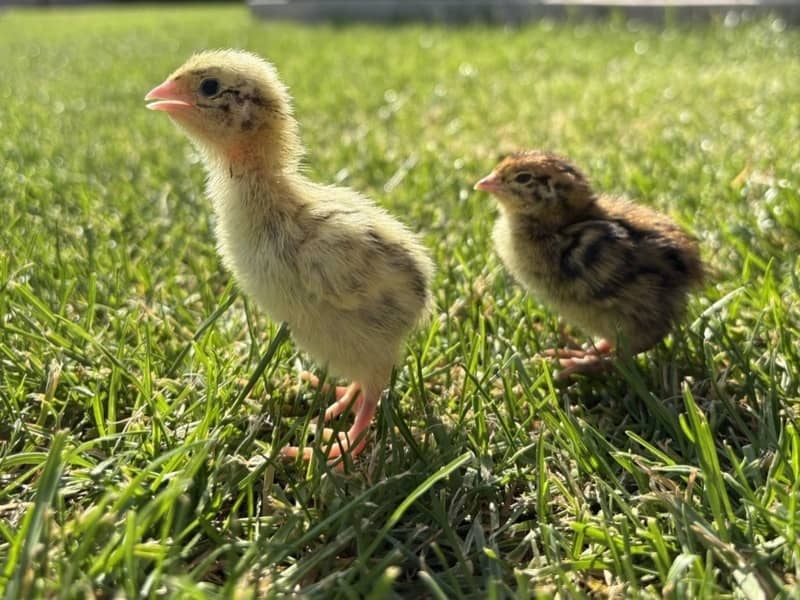
An Italian quail can never be a true-breeding line, because it is always heterozygous. If you want all chicks to be Italian, pair a Manchurian with a Pharaoh. The Manchurian passes Fawn to every chick, the Pharaoh passes the original allele, and only Italian quail will hatch.
Names overview: Italian, Manchurian, golden and Fawn
The same quail appear under different names in classified ads, on forums and in the literature. The table shows what each name means and how many copies of the Fawn gene a quail with that name carries.
| Name | What it means | Fawn copies |
|---|---|---|
| Italian, Golden Italian | Italian quail | 1 |
| Manchurian, Golden Manchurian | Manchurian quail | 2 |
| Golden, yellow | Colloquial label, can mean either an Italian or a Manchurian quail | 1 or 2 |
| Jumbo Gold | Italian or Manchurian quail from a line bred for weight | 1 or 2 |
| Italian Giant | Mostly a marketing name for the Jumbo Gold quail, not a separate variety | 1 or 2 |
| Fawn | Name of the gene, not of a colour variety | - |