Jumbo Pharaoh: what the name actually means
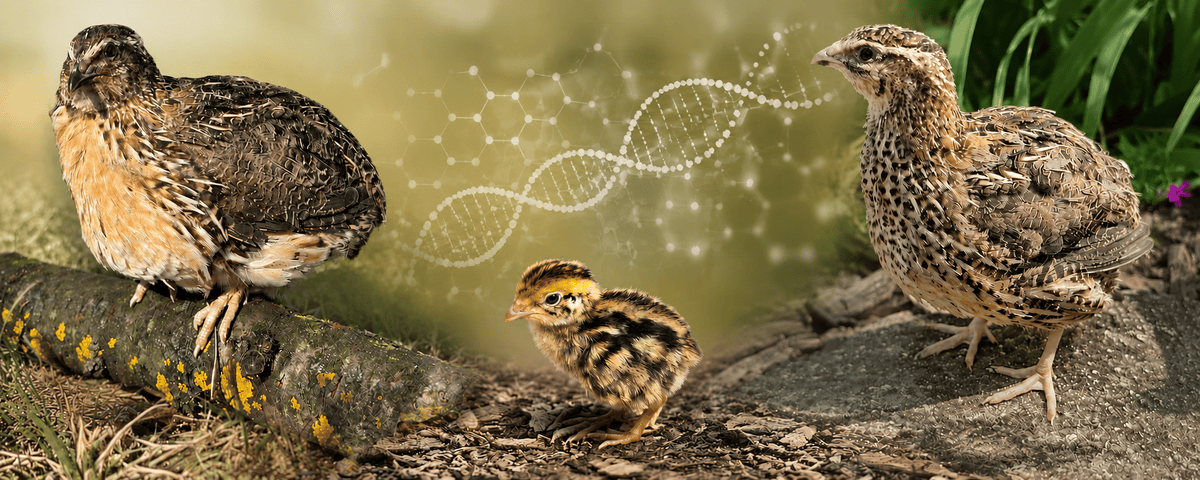
You may have come across a classified ad along the lines of "for sale: Japanese quail Jumbo Pharaoh meat-and-egg type, about a third are yellow". The sentence sounds harmless, but an experienced keeper reads two things into it at once: the flock is not a genetically clean line, and the seller most likely does not know what the terms Jumbo and Pharaoh actually mean. And that is the heart of it: Jumbo and Pharaoh are not two words for the same thing, they describe two completely different properties of the bird. Let us take them apart one at a time.
What Pharaoh actually means
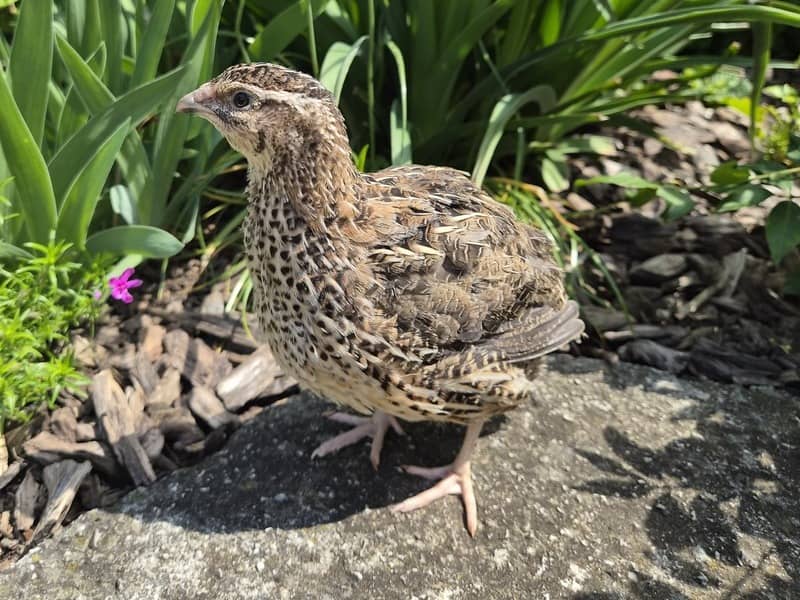
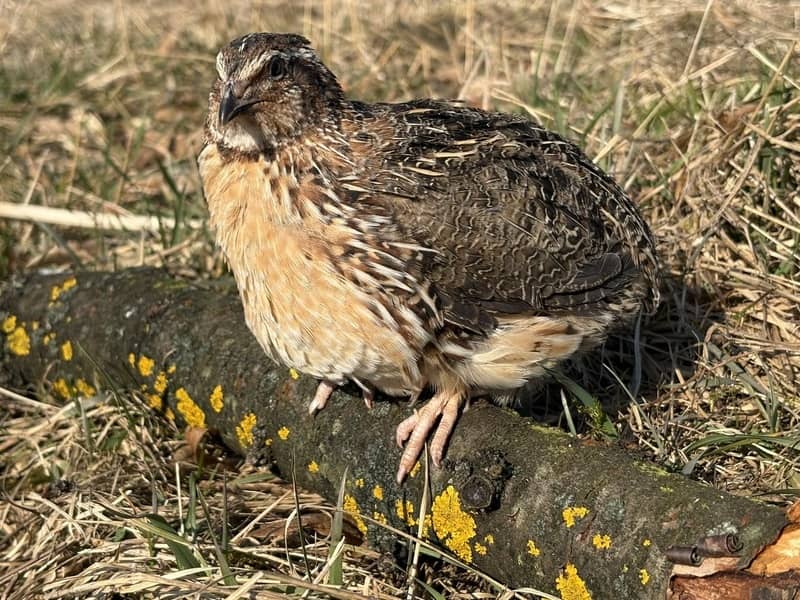
Let us start with the colour. Pharaoh is the English name for the wild type of Japanese quail Coturnix japonica. In the US breeding world, where the name comes from, "Pharaoh" means the same thing a zoologist would call wild type: the colouring carried by free-living Japanese quail without any colour mutation.
Pharaoh plumage has a brown and tan base with golden vertical stripes along the back and subtle markings on the head. It is the colour worn by Japanese quail living in the Asian steppes from eastern China to Japan. From a genetics point of view, Pharaoh is the reference point against which all other colour varieties are defined. It is not a breed in the zoological sense, it is the original, non-mutated form of the species.
How the other colour varieties arise from Pharaoh
Every known colour variety of Japanese quail arose from mutations stacked on top of the original Pharaoh colour. Many of these mutations are recessive, so they can hide in a flock for several generations and only show up in the plumage when a bird inherits the mutation from both parents.
Why two Pharaoh parents can hatch differently coloured chicks
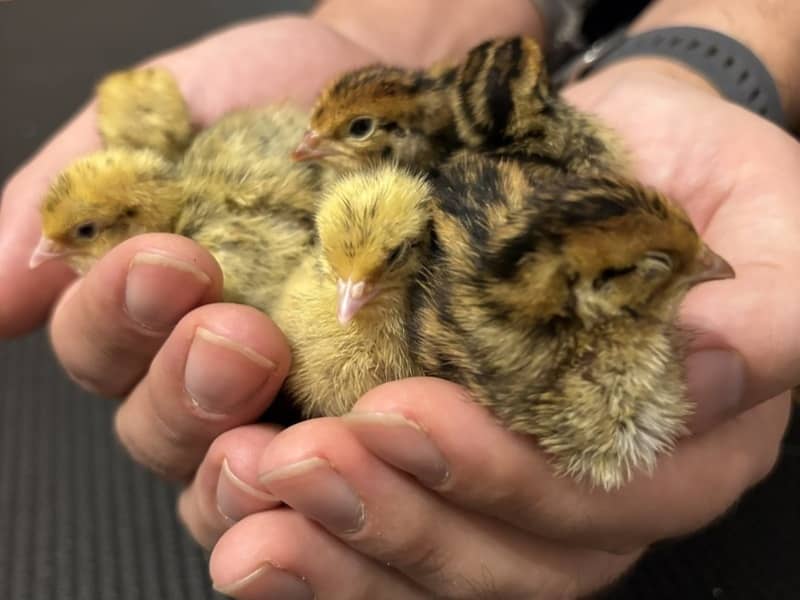
Look at the two rows in the table where the offspring is hard to tell apart from a Pharaoh. A bird with a single Fee gene (a heterozygote) looks almost exactly like a clean Pharaoh, and a Pharaoh with one copy of English White shows a few white feathers at most. On the outside they pass as ordinary Pharaohs, yet they secretly carry a mutation.
The trouble starts when you pair two such hidden carriers. Imagine two parents that each carry a single Fee gene. They are two outwardly ordinary Pharaohs, but a quarter of their offspring statistically inherit the Fee gene from both parents and hatch as a visible Falb fee.
The same goes for English White. If both parents look like Pharaohs but each quietly carries one white allele, roughly a quarter of the chicks hatch as English White. All it takes is overlooking a few white feathers on the parents.
And that is only the beginning. Quail colour genetics involves a large number of genes, and many of them are completely invisible in the heterozygous form. That is exactly why a flock that looks like clean Pharaohs can hatch chicks of various colours. It is not a hatching error but proof that the parent flock is not a genetically fixed clean line.
Want to get rid of the hidden genes? Cull the suspect birds and never cross with other colours. After a few generations the hidden mutations will fade out of the line.
What Jumbo actually means
The word Jumbo describes neither a colour nor a breed, but a line developed by long-term selection for above-average body weight. Broadly, a Jumbo is a line that consistently and repeatedly (not in a single random clutch) reaches a body weight of at least 280 grams in males and 340 grams in females by eight weeks of age.
The key point is that this is not about individual birds. A female weighing 340 grams is not automatically a Jumbo, and a lighter one is not automatically out. For a line to count as Jumbo, it has to reach this weight reliably in at least 80% of every generation of offspring. Jumbo is therefore a property of the whole fixed line, not of a single heavy bird.
This kind of weight selection works on any colour variety, which is why you will also find Jumbo Italian, Jumbo Tuxedo or Jumbo Tibetan abroad. The first Jumbo lines appeared in the second half of the 20th century in the US and Canada, and to this day the word "Jumbo" in front of a colour name means just one thing: the line was bred for size.
Weight and colour are unrelated
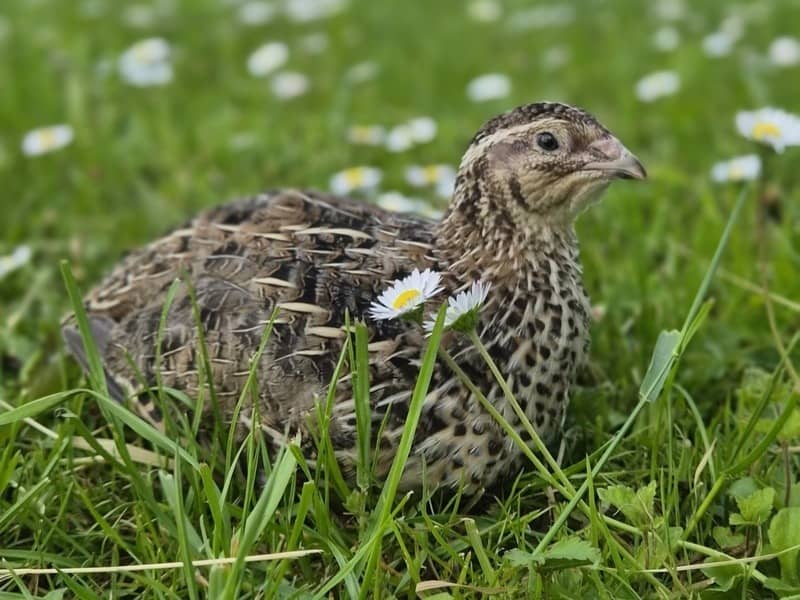
- A Pharaoh does not have to be Jumbo – smaller Pharaoh lines with an adult weight of around 200 to 250 grams are still common across Europe.
- A Jumbo does not have to be Pharaoh – in our flock we also keep a jumbo golden line with the same weight but a different colour.
- Jumbo Pharaoh names two things at once – the natural colouring (Pharaoh) and the selection for body weight (Jumbo). Both are independent choices made when the line was originally established.
Jumbo Pharaoh is a Japanese quail (Coturnix japonica) with the natural brown and gold colouring, developed by long-term selection for an above-average adult body weight.
See Jumbo Pharaoh in our flockJapanese quail breeder and founder of Cipinkovo, focused on genetics and selective breeding. I write about what I have learned over years of practice.